Exotic India Art is a One-stop finest handmade product provider E-commerce Indian brand dealing since 1998. You will get the product's doorstep delivery facility with complete transparency and without adding any hidden extra charges. You will get products based on Indian Culture, Religion, Tradition, and Region. Here you will get beautifully carved and handmade products based on Indian Arts, Paintings, Books, Textiles, Jewelry, Beads, Sculptures, Home Decor, Home & Living, Ayurveda, Audio, Video, and much more.
Rajarajeshwari is one of the most beautiful female figures in all of the three worlds. She is a royal manifestation of Shakti and personifies grace and balance. Trailokya Sundari or Tripura Sundari, as she is often named, is the presiding deity of Sri Chakra. Hers is the path of transcendence through the material world of senses. She presides over the Sahasrara as well the Swadhisthan Chakra. Her devotees are blessed with good thoughts, good health, and success in life.
A brilliantly crafted Rajarajeshwari brass statue of the four-armed female divinity that we have for you here. She is represented with a perfectly symmetrical heart-shaped face. Her royal haloed crown is complemented by the elaborate neck ornaments and the ornate girdle around her waist. The upper right-hand carry an elephant goad. She holds a noose in her upper left and a sugarcane staff in her lower left. She is shown sitting in lalitasana, the posture of royal ease, upon a Cajon. Her lower right-hand stretches out in Abhaya Mudra, blessing her devotees.
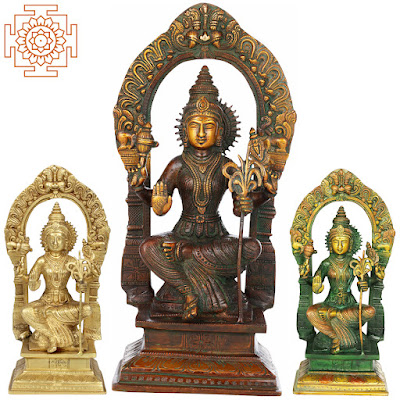 |
| Goddess Rajarajeshwari - Brass Sculpture |
The entire Brass Statue, framed by a fire-arch, Prabhavali, stands upon a rectangular podium. The fire-arch is topped by a kirtimukha - an auspicious symbol of accomplishment. This brilliant brass statue of a four-armed female divinity with a round face, well-fed cheeks, subdued chin, eyes, three-fourth shut as when absorbed in meditation, well-aligned beautifully modeled nose and moderately elevated neck represents Tripura-Sundari, also called Trailokya-Sundari – the most beauteous female – human or divine, in all three worlds. With broad shoulders, sensuously modeled but as decently clad breasts, subdued belly further contained by an elaborate girdle, broadened hips, moderate height …, the anatomy of her figure is highly balanced. The four-armed divinity is carrying in her upper hand's elephant goad and noose, in the normal left, sugarcane, while the normal right is held in ‘Abhay. Seated on a tall seat with her figure straightened there reflects absolute ease in her bearing, With her left leg horizontally stretched along the seat’s top, and the right, laid suspending downwards, the goddess is seated in ‘lalitasana’. She is clad in a sari – an unstitched textile length. It is so worn that on the upper part of the figure it is as tight fitted as a sewn costume, and on the lower side, as loose as the traditional ‘antariya’. Though her ornaments are a bit voluminous and heavy, and so her crown and halo consisting of lotus-buds, they perfectly fit her figure.
The seat Tripura-Sundari is sitting on is narrow but moderately tall. Installed with a magnificent ‘prabhavali’ – fire-arch, behind, it looks like covering its breadth from right to left. Raised over a high podium, carried on the sides over massive dwarf columns such as carry on them roofs in ancient temple architecture, and topped by a ‘kirtimukha’ – the symbol of accomplishment and auspiciousness, the ‘prabhavali’ looks like a sanctum. Thus, the fire-arch transforms into a sanctum that Tripura-Sundari enshrines. As is usually the style of a sanctum’s door, on inside the arch is a perfect round whereas it resorts to a conical form on the top on the outer side. This is by and large the usual pattern of defining entrances in early shrines, Buddhist, such as are the entrances at Ajanta, in special. A pair of mythical elephants installed over the pillars carries the arch over their backs. A deep half circle with a relative plain edging line defines the arch’s inner frame, while a row of successive semi-oval rings, its breadth. The podium, the fire-arch rises over, is multi-tiered consisting of plain and lotus moldings.
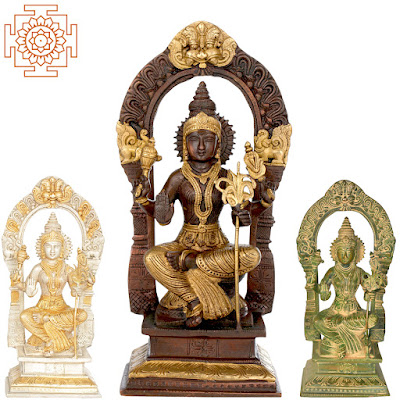 |
| Tripura Sundari - Brass Statue |
Three of the Upanishads – Tripura Upanishad, Tripura Tapini, and Bahvrich Upanishad, allude to Tripura-Sundari and as such Tripura-Sundari was a Upanishadic deity; however, for quite long, till about the 10th century, she has not attributed the status of a classical deity. At the most, she was seen as the transformation of Trailokya-Mohini, Lord Vishnu’s female incarnation by whose fascinating beauty in the course of ocean-churning he had succeeded in beguiling demons and frustrating their design to take away ambrosia. So bewitching that it not only beguiled demons but also gods, sages, and human beings, Vishnu’s Mohini form was immediately lauded as Trailokya Mohini, the woman who deluded all three worlds by her beauty. Though Vishnu’s act was soon exposed, Puranas immortalized Trailokya-Mohini under various names one being Tripura-Sundari.
By around the tenth century there evolved the concept of Mahavidyas – great wisdom. One of the instruments of wisdom was beauty that inspired intellect through emotions and Tripura-Sundari, also known as Sodasi, was seen as personifying such faculty. Obviously, her form evolved from Lord Vishnu’s Mohini incarnation that Puranas alluded to. As such, Trailokya-Mohini or Tripura-Sundari form represented the beauteous aspect of Mahavidyas. Thus, Tripura-Sundari was elevated to the status of one of the Mahavidyas. One Mahavidya-tradition names this beauteous aspect as Sodasi, literally meaning ‘of sixteen years, that is, the goddess stayed, and stayed ever, at sixteen years of age ever abounding in youthfulness as a woman has at sixteen. Other traditions saw Sodasi only as a transform of Tripura-Sundari. The tradition identifying Sodasi and Tripura-Sundari as independent divinities classify Tripura-Sundari as one of the Matrikas, and Sodasi, more often, as Tantrik deity. Though a transform of Trailokya Mohini, a form of Vishnu, Tripura-Sundari is perceived as a Shaivite deity having strong Shaivite links. As befits Tripura-Sundari’s form, the aspect that this image emphasizes is maturity besides beauty and elegance.
Comments
Post a Comment